

This free bus helps Fort Lauderdale’s homeless. But it's running out of money
Updated: May 7
BROWARD COUNTY This free bus helps Fort Lauderdale’s homeless. But it's running out of money
By Amanda Rosa January 14, 2026 5:30 AM

People ride on the bus run by Rotary Connection, a nonprofit initiative that offers free bus transportation to social services around the city, to LifeNet4Families on Monday, Jan. 12, 2026, in Fort Lauderdale, Fla. Alie Skowronski askowronski@miamiherald.com
Vandella Brown woke up Monday morning to harsh news. She was being discharged from the drug rehabilitation center she was staying in, which meant she had nowhere to sleep that night.
By 11 a.m., she was standing in North Fork Riverfront Park, along with dozens of other homeless people, waiting for help from a nonprofit that gets people into shelters. But she heard her chances of getting a bed that night were slim, “and I started losing hope.”
After a few minutes, a man handed her socks, a toothbrush and a flyer for the Rotary Connection, a free 14-seat mini bus that brings homeless people directly to dozens of services, resources and nonprofits in Fort Lauderdale. By 11:15 a.m., Brown, 27, was sitting on the small bus, which was ready to take her to a center that had a bed for her.
“It was from God,” Brown told the Herald, wiping away tears.

Vandella Brown smiles out the window during a ride with Rotary Connection after they found an open bed for her after being released from rehab that morning with nowhere to go on Monday, Jan. 12, 2026, in Fort Lauderdale, Fla. Alie Skowronski askowronski@miamiherald.com
Since it launched in August, the Rotary Connection has transported over 2,025 homeless people in the Fort Lauderdale area and gotten 67 people off of the streets, either reunited with their families or into residential treatment facilities. In its first month, 103 people rode the bus. In December alone, the bus program gave 687 people rides, reunited 11 people with family and brought nine people to treatment, according to the Rotary Connection’s community impact report.
At his State of the City address last year, Fort Lauderdale Mayor Dean Trantalis said homelessness “remains one of our greatest challenges facing our community,” even as the city experiences a “renaissance” in real estate development and economic growth. In the following months, the Rotary Connection, which is operated by Fellowship Recovery Community Organization, has emerged as a lifeline for the city’s homeless population. The bus brands itself as “more than just a ride.”
The bus program does not receive any government funding, instead relying on donations and corporate sponsors. Some in the community, including local government officials, were skeptical of the idea at first, said Garry Smyth, a Rotary Connection co-founder and the man who found Brown a place to stay. But the bus’s popularity and effectiveness in just five months isn’t just proof of concept, he said, it was a total surprise.
“I don’t think we had any idea how quickly the community would come to recognize it as an asset,” Smyth said. “We thought it would have success, but we had no idea about the success that it would have. The awareness level of the program has just blown us all away.”

People board the Rotary Connection bus, a nonprofit initiative that offers free bus transportation to social services around the city, on Monday, Jan. 12, 2026, outside of LifeNet4Families in Fort Lauderdale, Fla. Alie Skowronski askowronski@miamiherald.com
The Rotary Connection can serve as a model for free homeless bus routes in other South Florida cities, Smyth said, but it’s not all smooth sailing for the small but mighty bus. The money used to maintain the bus and cover expenses like gas, insurance and the drivers’ paycheck is running low.
The $4,000 left for the bus will only last two weeks, Smyth said. If the money runs out, the bus stops running.
While standing on the very full bus Monday morning, Rotary Connection co-founder Gwynne Beatty said the bus costs at least $20,000 a month — adding up to $250,000 a year — to operate. That sum doesn’t include any payment for herself or Smyth, who is on the bus almost daily. Not to mention the air conditioning that broke a few days ago.
“We are eking by,” Beatty said.
The daily route
On a dreary Monday across the street from the Broward County Transit Central Bus Terminal, Smyth set out to find people in need, socks and flyers in hand. The socks are a good conversation starter, he said. Everyone can use a new pair of socks.
The bus filled in no time. Standing room only.
Rick Riccardi, the former Rotary Club of Fort Lauderdale president and Fellowship Recovery Community Organization founder, came up with the idea for the bus a couple of years ago. Though there are many organizations and nonprofits in the area that offer help for the homeless community, Riccardi said, transportation to those resources is a major hurdle. The project secured funding from the Florida Blue Foundation and local nonprofits Changing Lives of Boca Raton and Go Therefore to purchase, repair, insure and beautify the bus.
There are no police officers on the bus to ensure riders feel welcome, Riccardi told the Herald. Florida’s homeless population has feared getting arrested by law enforcement after a state law made it illegal to sleep in public, though Broward County Sheriff Gregory Tony has said he wouldn’t put homeless people in jail. Instead, there are two people working on the bus at all times: the driver and a peer resource navigator who specializes in outreach. That person is usually Smyth.

Garry Smyth, center, co-founder and executive director, hands out drinks out of the back of the bus run by Rotary Connection, a nonprofit initiative that offers free bus transportation to social services around the city, while Alex Wright, left, hangs out waiting for the bus at LifeNet4Families on Monday, Jan. 12, 2026, in Fort Lauderdale, Fla. Alie Skowronski askowronski@miamiherald.com
“When you’re experiencing homelessness, you’re vulnerable to bullying, to crime, to getting robbed,” Beatty said. “People come on the bus because they feel safe. It’s not a dangerous place.”
The bus makes 62 stops daily, stopping at food pantries, health centers, government buildings, legal services, churches and more. At each stop, Smyth conducts a “warm hand-off,” walking bus riders into the services and introducing them to intake staff. He also introduces himself to more people there, hands out socks and bus flyers and offers to reunite people with their families that same day.
The Rotary Connection reunification efforts have ramped up. Volunteers bought 20 bus tickets last year. Just this month, they bought five. Recently, Smyth met a man at a homeless resource fair who wanted to go back to Baltimore, where he had an uncle who said he’d take him in. Smyth quickly got him a Greyhound bus ticket. “You have to strike while the iron is hot,” Smyth said.
The Rotary Connection drove to LifeNet4Families, a nonprofit that offers a hot meal, showers and other resources. “Dang, that’s a full house,” one man said, looking into the crowded bus.

Sue Marsh receives a Rotary Connection bus schedule,a nonprofit initiative that offers free bus transportation to social services around the city, while waiting at LifeNet4Families on Monday, Jan. 12, 2026, in Fort Lauderdale, Fla. Alie Skowronski askowronski@miamiherald.com
As Smyth handed out socks and bus flyers, Sue Marsh asked for an extra one to hand out to people in need. Though she is not homeless herself, Marsh said she deals with health issues and comes to LifeNet for a hot meal. She’s used the Rotary Connection a few times to get to Broward Health. Many Rotary Connection riders hear about the bus through word-of-mouth, thanks to people like Marsh.
“It’s wonderful. I do see people out on the ride that don’t have a ride, and they’re not sure what bus to ride, and I give them this,” Marsh said, holding up the flyer. “It helps. A lot of people need to go to these specific places where the other buses do not go.”
Keeping the bus alive
Fort Lauderdale City Commissioner Ben Sorensen hopped on the bus Monday for a ride, chatting with passengers and passing out socks at LifeNet. Besides city waterways, homelessness is one of Sorensen’s top concerns.
“It’s not only from a value standpoint, who we are as a city, who I am as a commissioner,” Sorensen told the Herald. “Our community can only move as forward as we lift up those who are facing difficult times.”
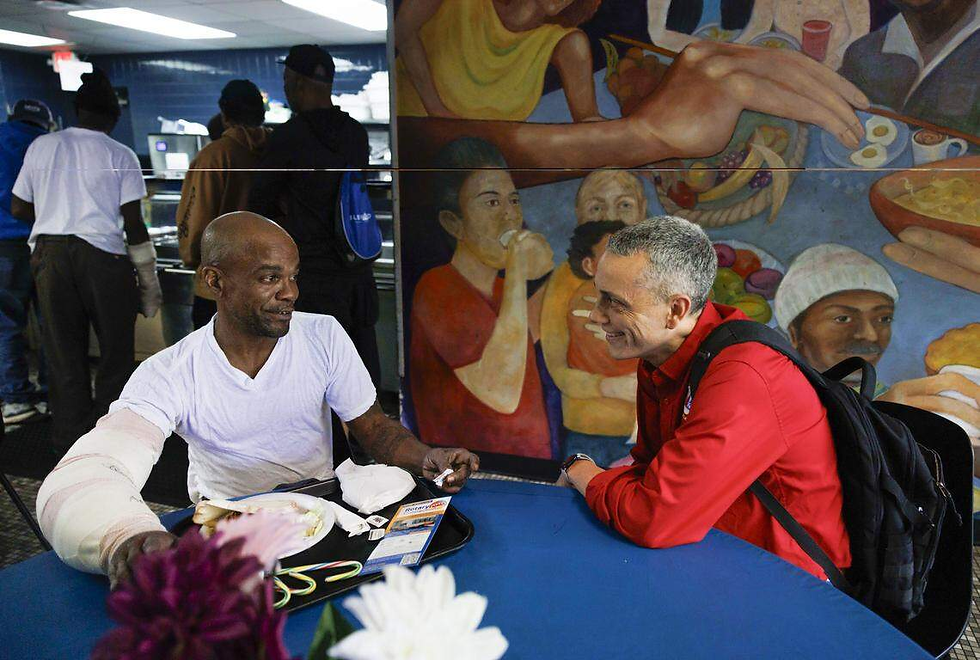
Commissioner Ben Sorensen, right, talks with Artavious Hall in the dining room of LifeNet4Families on Monday, Jan. 12, 2026, in Fort Lauderdale, Fla. Sorensen is interested in tackling homelessness in the community and visits LifeNet4Families often. Alie Skowronski askowronski@miamiherald.com
One challenge the city faces is that its home to the county bus depot, county jail and several major hospitals, which means many people experiencing homelessness in other parts of the county often end up in Fort Lauderdale, Sorensen said. Additionally, housing costs and overall cost of living has skyrocketed, leaving many South Floridians dangerously close to becoming homeless themselves.
The City of Fort Lauderdale allocates $13 million a year to address homelessness. In September, the mayor announced the city was expanding its homelessness response by increasing staff and reorganizing the team to better address the homeless community’s needs.
“From a resource perspective, being homeless on the streets of any major city is much more costly than housing and providing the support to get those folks all that they need,” Sorensen said. “So from an economic standpoint, it makes sense. From a value standpoint, it makes sense.”
The city does not provide funding to the Rotary Connection as of now, “but we’re exploring the possibility,” Sorensen said.
“We’ve talked about it [working with Rotary Connection], but haven’t talked about specifically providing funding,” he said. “I wanted to spend time here, experience it myself, so that I can best understand the program and then bring it back to the commission.”
Without a reliable source of funding, the Rotary Connection project is not sustainable, Smyth said. The Rotary Connection team approached local government officials asking for financial support “when it was just an idea on a piece of paper,” but they were hesitant to give money without knowing if the bus would work in real life.

Alex Wright takes a ride on the Rotary Connection bus, a nonprofit initiative that offers free bus transportation to social services around the city, on Monday, Jan. 12, 2026, in Fort Lauderdale, Fla. Alie Skowronski askowronski@miamiherald.com
“Everyone said, ‘No, no, no, when you have numbers, come on back.’ Well, we’ve got numbers,” Smyth said. “They’re pretty impressive, and we have a pretty good, solid reputation.”
He added, “No one’s said ‘no,’ but no one’s written a check.”
In the meantime, the Rotary Connection is looking for donations from individuals and support from businesses, Beatty said. City and county funding is “the long game” since it’s time-consuming to advocate and apply for.
Still, the Rotary Connection co-founders have big ideas for their little bus. That includes another (ideally larger) bus in Fort Lauderdale, starting similar bus routes in Hollywood and Pompano Beach and even pitching the idea to New York City Mayor Zohran Mamdani. It seems like something he’d be into, Beatty said.
As the bus pulled into North Fork Riverfront Park, the cramped bus riders got up to stretch their legs.
Montene Daniel rode the bus to the park to meet with the TaskForce for Ending Homelessness, a group that connects homeless individuals to shelters. After getting off the bus with her large pink suitcase, Daniel said the bus was very safe and helpful, though she had one critique.
“The resources are there. The good people are there,” she said. “But they need a bigger bus.”


Comments